


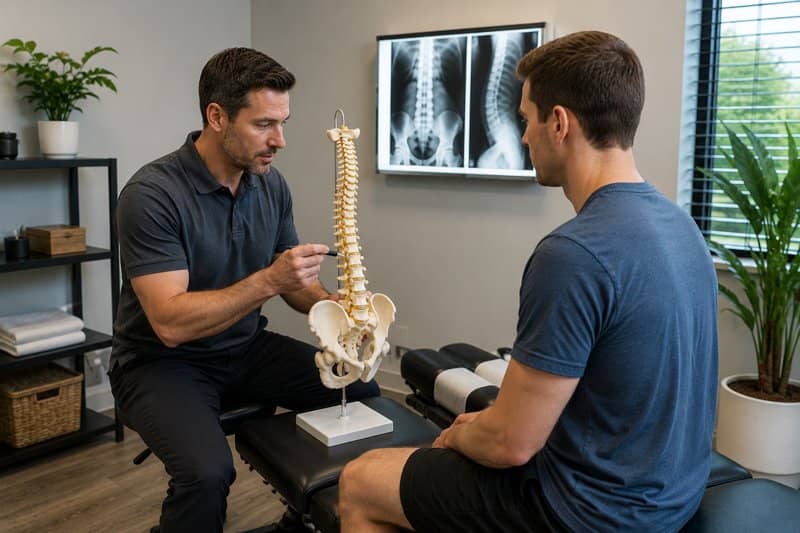
You may have visited a chiropractor who started adjusting your back as soon as you were on the table. After a few quick pops, they sent you on your way. This type of visit might provide some relief, but not always. And for many the pain often returns after a few days.
Adjustments are only one part of chiropractic care. If your chiropractor only does adjustments without identifying the source of your pain, you may not see the improvement you need. A thorough visit begins with a close examination of your spine, movement, and history before anything else.
Pain Isn’t Always the Problem
Pain is often the reason you schedule a chiropractic visit, but it isn’t the only thing your chiropractor should evaluate. Pain is often the last signal the body sends, not the first. By the time you feel it, the underlying mechanics may already have been changing for a while. An issue in one part of your body may be causing symptoms somewhere else.
A pinched nerve in the lower back can send shooting pain into your leg. A stiff neck might be causing your headaches. The symptom and the source can be in entirely different locations.
A Gonstead examination looks beyond the area where you feel pain. It evaluates spinal alignment, movement patterns, posture, and nerve function to identify the specific source of the problem. When a provider identifies the exact spinal level, they can provide focused care instead of generalizing it. This approach helps avoid treating areas that are only compensating rather than causing the issue.
When a chiropractic visit skips the investigation or keeps it brief, the adjustment only targets the most obvious area. That may lead to some improvement. But without addressing the underlying issue, the symptoms may continue.
A hasty assessment can also completely miss things. Some structural problems develop gradually with no symptoms in their early stages. A thorough chiropractic exam can identify the early signs of a compressed disc compression or pinched nerve before they become the kind of problem that sidelines you for weeks.
Health History
The first part of your visit is one of the most important. A detailed health history might feel like unnecessary paperwork, but it’s a critical diagnostic tool.
Occupation
A farmer who has spent years operating equipment can have very different issues from someone at a desk job. Different jobs bring different problems, so knowing what you do and how you do it is the first step. This way, your chiropractor can start by focusing on the areas that are the most affected by your job.
Past Injuries
Events like a car accident from 10 years ago, a bad fall, or a sports injury in your twenties can all affect the spine, even if it doesn’t show up right away. That sprained ankle from years ago may have changed the way you walk and, over time, affected your hips or lower back. A recent fender bender may have caused whiplash. A chiropractor who knows about your past injuries can look for any damage they may have left behind.
Daily Habits
Questions about your sleep position, activity level, how long you stand or sit each day, and whether one foot turns out when you walk can help build a clearer picture of what’s going on and explain why certain joints are under more stress.
Maybe you don’t need an adjustment, but a pillow that better supports your spine. Maybe your exercise routine is putting too much repetitive strain on a joint. That background information can help guide and focus the exam.
The evaluation doesn’t stop at your health history, but it provides the necessary foundation for the rest of the exam.
Physical Exam
During the physical, your provider looks for evidence of what you described in your health history in the spine itself. Remember, your chiropractor should be looking beyond the area that hurts to find the root cause.
Posture
If you have one shoulder sitting higher than the other, hips that aren’t level, or a head that juts forward, it might show where the spine has shifted from its normal alignment. These may be changes you’ve never even noticed because they developed so gradually.
Range of Motion
Range-of-motion testing shows where movement is restricted, guarded, or asymmetrical. A healthy spine should move smoothly and symmetrically. Any abnormalities can indicate issues. Where and when they show up can point to the cause.
Additional Assessments
Orthopedic and neurological tests can add more information and insight. Some practices, including those that use Gonstead technique, get an even clearer picture by using a heat-sensing instrument to detect inflammation and full-spine X-rays to document and track any abnormalities or changes.
Taken together, the findings can give the chiropractor a more precise idea of how they can help.
From Findings to Treatment
You should leave a chiropractic exam understanding exactly what was done and why. No jargon or vague promises. You deserve an explanation that goes beyond, “You’ve got some tightness in your lower back.”
No single test can provide all the answers. But your health history, physical condition, and movement all provide clues. Treatment decisions should be based on specific findings from your exam, not just symptoms. That way, you can get the type of care that leads to a solution, not a Band-Aid.